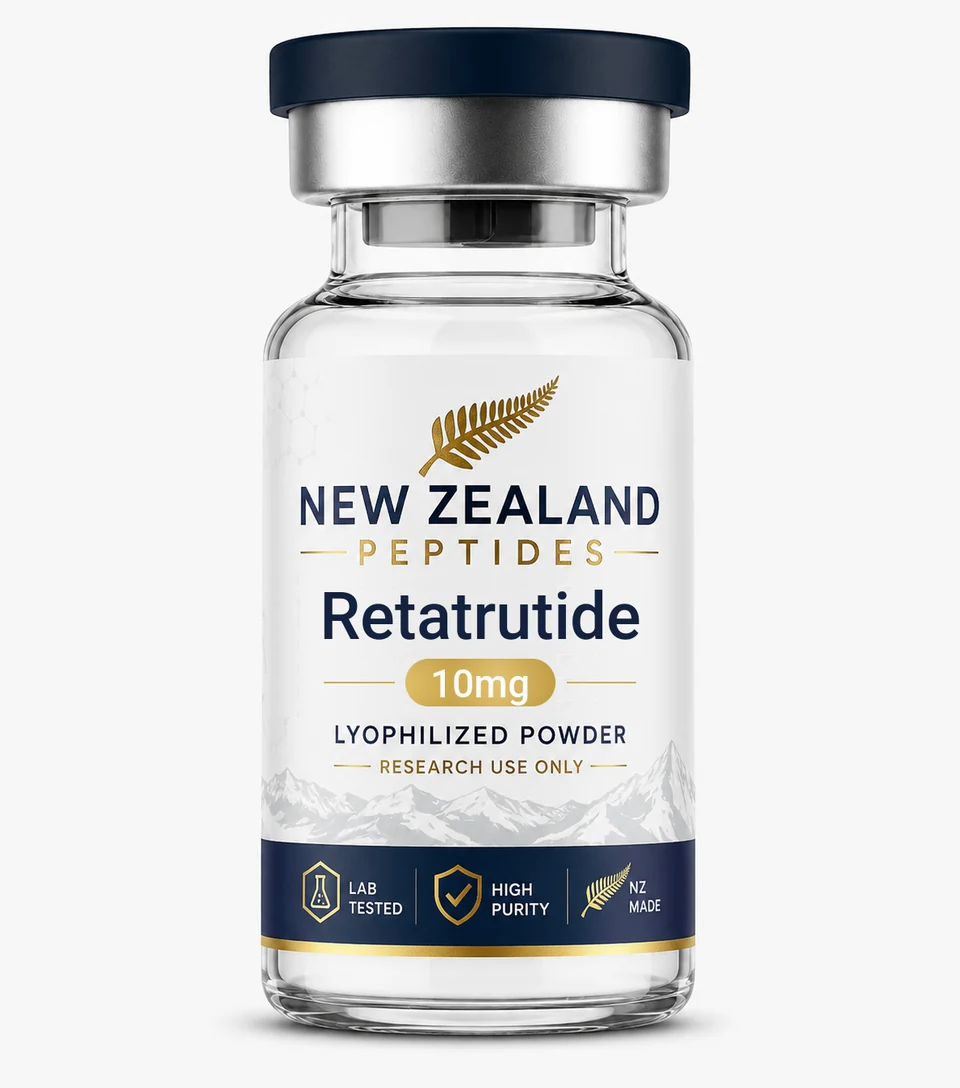
Retatrutide is the most requested compound on our New Zealand bench. This reference covers its triple-receptor pharmacology, the analytical evidence a lot should carry, and how to handle it once it lands in Auckland or Christchurch.
Retatrutide arrived on New Zealand research benches faster than almost any incretin analogue before it. Within two seasons it moved from an unfamiliar code name in trial abstracts to the single most-ordered lyophilised compound leaving our Auckland dispatch room. This reference explains what the molecule actually is, what evidence a legitimate lot should carry, and the handling realities of running it in a country where a courier bag can cross two islands and four climate zones in twenty-four hours.
What makes retatrutide structurally different
Retatrutide is a synthetic 39-residue peptide built on a GIP-like backbone and modified so that a single molecule engages three separate class B G-protein-coupled receptors: GLP-1, GIP and glucagon. Earlier incretin analogues bolted one or two of those activities together. Retatrutide is the first widely characterised research compound to carry all three in one chain, which is why the published literature refers to it as a triple agonist rather than a co-agonist.
A C20 fatty-diacid side chain attached through a linker gives the molecule reversible albumin affinity. In practical laboratory terms that extends its measurable half-life into the multi-day range and is the reason nearly every published protocol uses a weekly rather than daily interval. The same modification is what makes the mass spectrum distinctive, and it is the first thing our analytical partner looks for when confirming lot identity.
Receptor activity at a glance
| Receptor | Role in published models | Why researchers track it |
|---|---|---|
| GLP-1 | Incretin signalling and satiety pathways | Shared with semaglutide; provides a comparison anchor |
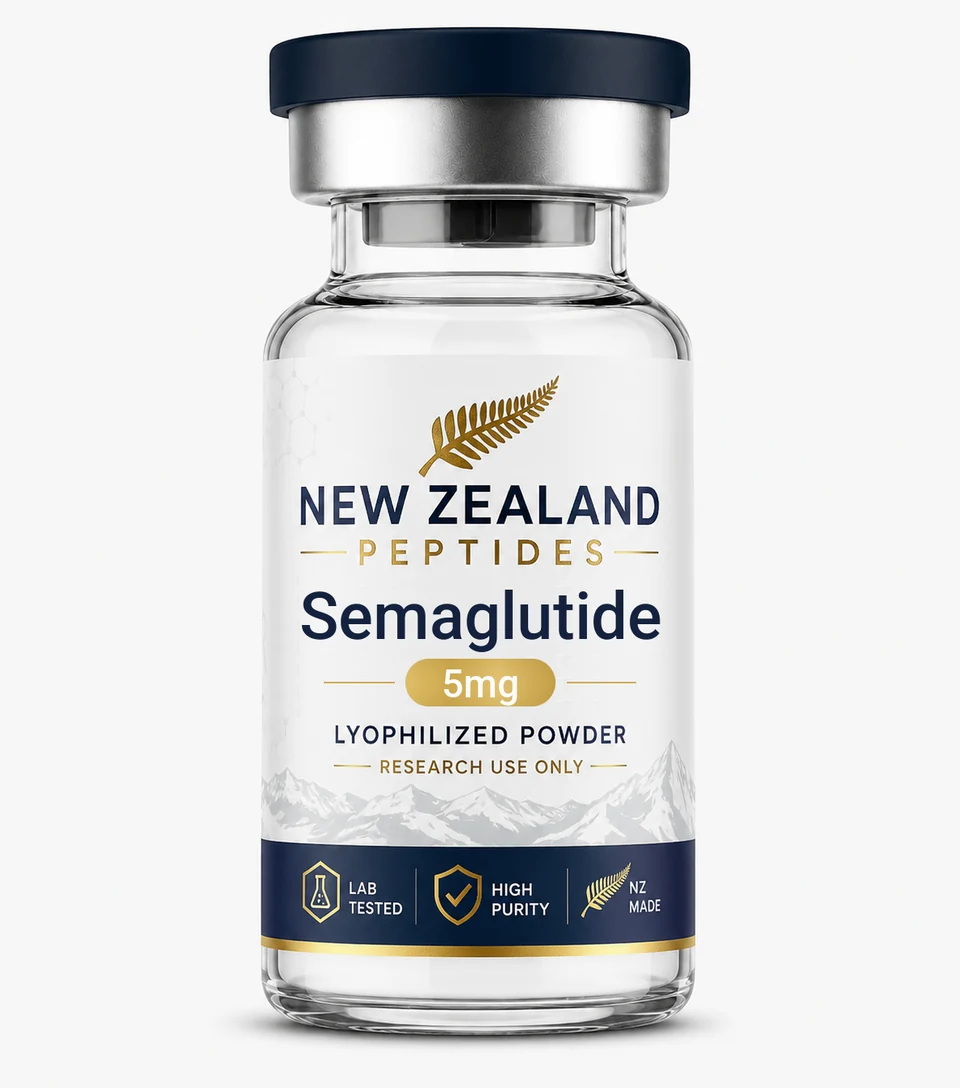
| GIP | Insulinotropic and adipose signalling | Shared with tirzepatide; separates dual from triple activity |
| Glucagon | Hepatic energy expenditure pathways | Unique to retatrutide among mainstream analogues |
Purity thresholds we will not ship below
Every retatrutide lot released to New Zealand customers is screened by reversed-phase HPLC and confirmed by liquid chromatography mass spectrometry before it is listed. Our internal release floor is 99% by HPLC area, which sits above the 98% figure most catalogues quote. Lots that fall between 98% and 99% are rejected outright rather than discounted, because a truncated-sequence impurity in a triple agonist is far harder to reason about than in a simpler chain.
- Reversed-phase HPLC area percentage, with the chromatogram reproduced in full rather than summarised
- LC-MS deconvoluted mass matched against the theoretical average mass for the intact chain
- Residual solvent and counterion content, since trifluoroacetate load changes the effective peptide fraction of a stated milligram figure
- Water content by Karl Fischer, which predicts how the cake behaves after months in a -20 °C freezer
- Appearance and reconstitution notes for the specific lot, not a generic paragraph reused across the catalogue
Handling retatrutide in New Zealand conditions
New Zealand geography creates a handling problem that northern-hemisphere guidance rarely addresses. A vial can leave a temperate Auckland warehouse, sit in an unheated rural delivery van in the Waikato, and arrive in a Central Otago lab where the ambient temperature is fifteen degrees lower. Lyophilised retatrutide tolerates that transit window well, which is exactly why we ship it dry rather than pre-reconstituted.
- Inspect the cake on arrival. A retatrutide cake should be white to off-white and intact; a collapsed or glassy cake indicates a temperature excursion worth reporting.
- Move unopened vials to -20 °C within a few hours of delivery. Short ambient exposure during courier transit is expected and accounted for in the stability data.
- Log the lot identifier printed on the vial against the certificate on our batch register before the vial is opened.
- Once reconstituted, keep working solution at 2–8 °C, protected from light, and treat the published thirty-day window as an outer limit rather than a target.
- Never refreeze reconstituted material. Freeze-thaw cycling is the most common cause of unexplained potency drift in bench data.
Why we made it our lead product
Stocking decisions at New Zealand Peptides are driven by two things: how often a compound is requested by New Zealand researchers, and how reliably we can source it at a purity we are willing to publish. Retatrutide scores highest on both counts, so it sits at the front of the catalogue with deeper stock cover than anything else we carry. That means a Wellington or Hamilton order placed before 2pm NZST ships the same working day from local inventory rather than waiting on an overseas consignment and a customs queue.
Common questions from New Zealand labs
Is retatrutide held in stock inside New Zealand?
Yes. All retatrutide lots are warehoused locally in Auckland and dispatched by NZ Post Courier, so nothing you order crosses a border after purchase and no customs clearance is involved.
How does retatrutide differ from a dual agonist like tirzepatide?
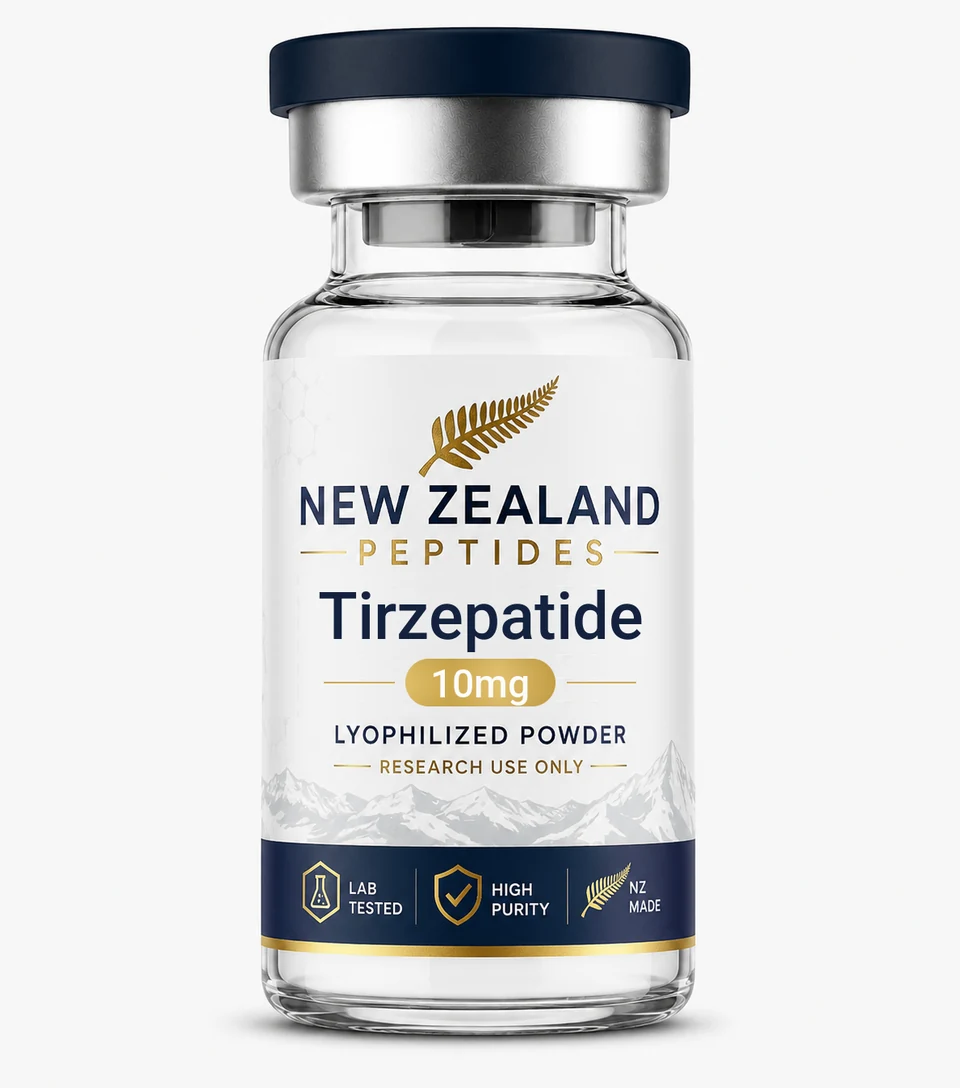
Tirzepatide engages GLP-1 and GIP. Retatrutide adds glucagon receptor activity as a third arm, which is the distinguishing feature in the published literature and the reason the two compounds are not analytically interchangeable.
What documentation ships with a retatrutide order?
Every vial carries a printed lot identifier that resolves to a certificate of analysis on our public batch register, including the HPLC chromatogram and the LC-MS trace for that specific synthesis run.
How long does delivery take within New Zealand?
Orders confirmed before 2pm NZST leave the same working day. Most North Island metro addresses receive next working day; South Island and rural delivery addresses typically add one to two working days.
Why Retatrutide nz matters to research labs
New Zealand research teams evaluating retatrutide nz face three recurring questions before any in-vitro work begins: is the compound what the label claims, will it remain stable across the planned experimental window, and does the supplier's documentation hold up to the standards a principal investigator will sign off on. The remainder of this article is structured around those three questions.
New Zealand Peptides supplies retatrutide nz as a lyophilised research material packaged for transit at ambient temperatures and long-term storage at −20 °C. Every batch ships with a lot-specific certificate of analysis covering identity, purity, residual solvents and endotoxin where downstream cell culture work is anticipated.
Typical research applications
Across the published literature, retatrutide nz appears most often in three workflow categories. Each has its own documentation profile and storage requirements, which is why a single supplier batch is frequently subdivided across multiple aliquots to limit freeze-thaw cycling.
- In-vitro receptor binding and signalling characterisation, where milligram-scale aliquots are reconstituted fresh on the day of assay.
- Pharmacokinetic and stability modelling, where reconstituted material is sampled at defined time-points and analysed by RP-HPLC.
- Comparative reference work, where retatrutide nz is benchmarked against in-house standards or other published research compounds.
Storage and stability envelope
Lyophilised retatrutide nz is documented as stable for 24+ months at −20 °C protected from light. Once reconstituted, the published storage reference for most research peptides in this class is up to 30 days at 2–8 °C when handled aseptically; longer-term storage of reconstituted material is best achieved by single-use aliquoting at −80 °C to remove freeze-thaw variables from later analytical reads.
- Avoid storing reconstituted vials in the refrigerator door — temperature swings shorten usable life.
- Label aliquots with batch ID, reconstitution date and concentration so retrospective audit is straightforward.
- Do not refreeze previously thawed aliquots; integrate single-use volumes into the assay design from the outset.
Certificate of analysis — what to verify
Every New Zealand Peptides retatrutide nz lot is dispatched with a certificate of analysis (COA) tied to the batch identifier printed on the vial. Reviewing the COA before the material enters the workflow is the single highest-leverage quality control step a research lab can perform.
- Batch / lot identifier and synthesis date — both must match the vial.
- RP-HPLC purity, typically ≥98% for research-grade retatrutide nz.
- Mass-spectrometry identity confirmation (LC-MS or MALDI-TOF) within ±0.5 Da of the theoretical mass.
- Counterion identity and percent (acetate or trifluoroacetate are the most common).
- Bacterial endotoxin per the published analytical method, reported in EU/mg.
- Residual solvents and water content where the synthesis route makes them analytically meaningful.
Quality benchmarks New Zealand Peptides publishes
| Parameter | New Zealand Peptides Spec | Method |
|---|---|---|
| HPLC purity | ≥ 98% | RP-HPLC, UV 214 nm |
| Identity | ± 0.5 Da of theoretical mass | LC-MS or MALDI-TOF |
| Endotoxin | Reported per lot | LAL kinetic chromogenic |
| Counterion | Quantified | Ion chromatography |
| Water content | < 8% (typical lyophilised) | Karl Fischer |
Frequently asked research questions
Is the retatrutide nz supplied by New Zealand Peptides intended for human use?
No. All New Zealand Peptides material is supplied strictly for in vitro and laboratory research use. Nothing on this page constitutes medical, veterinary or therapeutic advice.
How is retatrutide nz shipped and how long is the transit-stable window?
Material is dispatched as a lyophilised powder, sealed and protected from light. Transit at ambient temperatures over typical New Zealand courier timelines is well within the published stability envelope for this compound class.
Will a Certificate of Analysis be provided with my retatrutide nz order?
Yes. Every batch ships with a lot-specific COA covering identity, purity and the analytical parameters listed in the quality benchmarks section above.
Can I request a specific batch or repeat lot of retatrutide nz?
Repeat-lot requests are supported for ongoing research programs; contact the New Zealand Peptides research desk with the previous COA reference and the team will hold inventory from a matching batch where available.
Further reading
Continue with the related New Zealand Peptides research references linked at the foot of this article, or browse the full research catalogue for the compound class profile, lab-results archive and laboratory documentation. For sourcing questions, the research team is available via the New Zealand Peptides contact page.