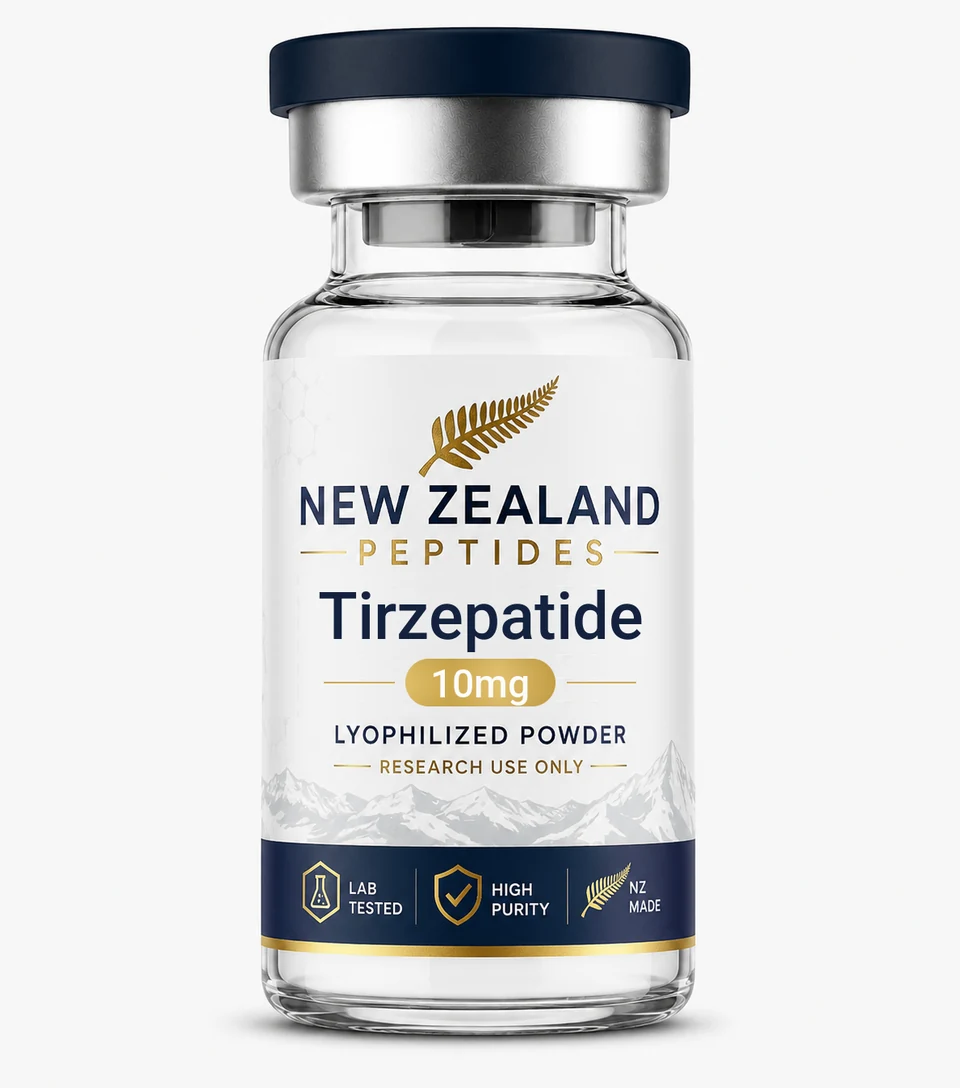
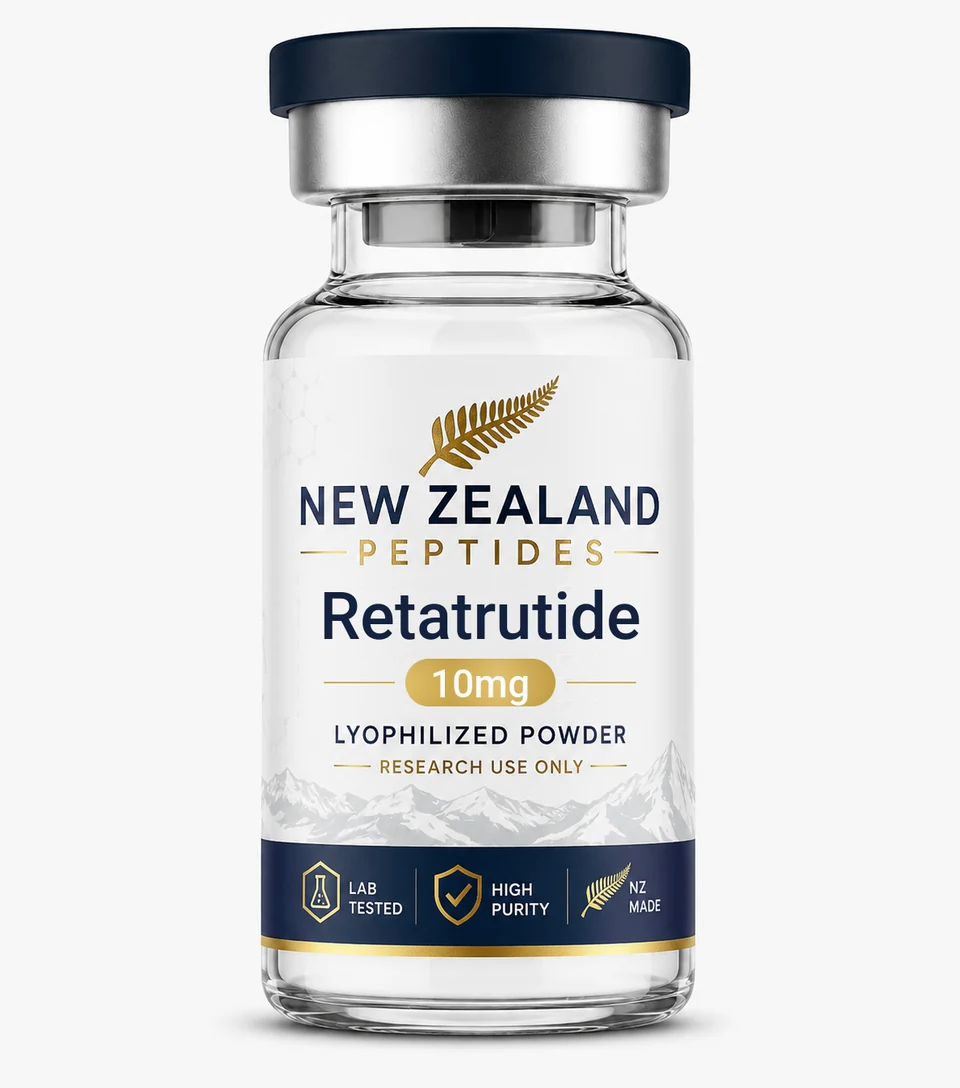
Three compounds, three receptor profiles, three completely different analytical fingerprints. A structural comparison for researchers deciding which incretin analogue their protocol actually needs.
These three compounds get grouped together in casual conversation as though they were versions of the same thing. Structurally they are not. They differ in backbone origin, chain length, receptor coverage and mass, and substituting one for another in a protocol invalidates the comparison you were trying to make. This article lays the three side by side.
Receptor coverage
| Compound | GLP-1 | GIP | Glucagon |
|---|---|---|---|
| Semaglutide | Yes | No | No |
| Tirzepatide | Yes | Yes | No |
| Retatrutide | Yes | Yes | Yes |
That table is the entire distinction in one view. Semaglutide is a mono-agonist derived from the native GLP-1 sequence. Tirzepatide is built on a GIP backbone and adds GLP-1 activity, making it a dual agonist. Retatrutide extends the same design philosophy to a third receptor by incorporating glucagon receptor activity.
Structural parameters
| Parameter | Semaglutide | Tirzepatide | Retatrutide |
|---|---|---|---|
| Backbone origin | Native GLP-1 | GIP analogue | GIP analogue |
| Residue count | 31 | 39 | 39 |
| Approximate mass | ~4114 Da | ~4813 Da | ~4731 Da |
| Lipid modification | C18 diacid | C20 diacid | C20 diacid |
| Published interval | Weekly | Weekly | Weekly |
Why the mass differences matter analytically
Tirzepatide and retatrutide share a residue count and a lipid modification class, which makes them superficially similar on a purity chromatogram run under a generic gradient. Their deconvoluted masses differ by roughly eighty daltons, which is trivially resolvable by mass spectrometry and completely invisible to HPLC alone. This is the single most practical argument for insisting on LC-MS confirmation: it is the only routine method that reliably distinguishes these two compounds from each other.
Choosing for a protocol
- Reproducing an established GLP-1 literature model with the deepest published dataset: semaglutide is the reference compound.
- Investigating incretin synergy where GIP contribution is the variable of interest: tirzepatide isolates that comparison.
- Examining hepatic energy expenditure pathways alongside incretin signalling: retatrutide is the only one of the three carrying glucagon activity.
- Building a dose-response series across receptor coverage: run all three under an identical protocol rather than substituting mid-study.
Handling and stability differences
All three are lyophilised solids stable at -20 °C for extended periods and all three reconstitute readily in bacteriostatic water. In practice we see slightly more variability in cake morphology with retatrutide lots, which is a lyophilisation-cycle artefact rather than a quality signal. Reconstituted refrigerated windows of up to thirty days apply across the group, with the usual caution that this is an outer bound rather than a plan.
Comparison questions
Can I substitute tirzepatide for retatrutide in an existing protocol?
Not without invalidating your comparison. The absence of glucagon receptor activity is a fundamental pharmacological difference, not a potency adjustment.
Do all three arrive as lyophilised powder?
Yes. Every incretin analogue we stock ships lyophilised, which is what allows courier transit across New Zealand without cold-chain packaging.
Which is most commonly ordered by New Zealand labs?
Retatrutide, by a clear margin, followed by tirzepatide. We hold deeper stock cover on both as a result.
Are the mass figures on your certificates monoisotopic or average?
Our certificates report deconvoluted average mass, with the theoretical value stated alongside the observed value for direct comparison.
Why Retatrutide vs tirzepatide matters to research labs
New Zealand research teams evaluating retatrutide vs tirzepatide face three recurring questions before any in-vitro work begins: is the compound what the label claims, will it remain stable across the planned experimental window, and does the supplier's documentation hold up to the standards a principal investigator will sign off on. The remainder of this article is structured around those three questions.
New Zealand Peptides supplies retatrutide vs tirzepatide as a lyophilised research material packaged for transit at ambient temperatures and long-term storage at −20 °C. Every batch ships with a lot-specific certificate of analysis covering identity, purity, residual solvents and endotoxin where downstream cell culture work is anticipated.
Typical research applications
Across the published literature, retatrutide vs tirzepatide appears most often in three workflow categories. Each has its own documentation profile and storage requirements, which is why a single supplier batch is frequently subdivided across multiple aliquots to limit freeze-thaw cycling.
- In-vitro receptor binding and signalling characterisation, where milligram-scale aliquots are reconstituted fresh on the day of assay.
- Pharmacokinetic and stability modelling, where reconstituted material is sampled at defined time-points and analysed by RP-HPLC.
- Comparative reference work, where retatrutide vs tirzepatide is benchmarked against in-house standards or other published research compounds.
Certificate of analysis — what to verify
Every New Zealand Peptides retatrutide vs tirzepatide lot is dispatched with a certificate of analysis (COA) tied to the batch identifier printed on the vial. Reviewing the COA before the material enters the workflow is the single highest-leverage quality control step a research lab can perform.
- Batch / lot identifier and synthesis date — both must match the vial.
- RP-HPLC purity, typically ≥98% for research-grade retatrutide vs tirzepatide.
- Mass-spectrometry identity confirmation (LC-MS or MALDI-TOF) within ±0.5 Da of the theoretical mass.
- Counterion identity and percent (acetate or trifluoroacetate are the most common).
- Bacterial endotoxin per the published analytical method, reported in EU/mg.
- Residual solvents and water content where the synthesis route makes them analytically meaningful.
Quality benchmarks New Zealand Peptides publishes
| Parameter | New Zealand Peptides Spec | Method |
|---|---|---|
| HPLC purity | ≥ 98% | RP-HPLC, UV 214 nm |
| Identity | ± 0.5 Da of theoretical mass | LC-MS or MALDI-TOF |
| Endotoxin | Reported per lot | LAL kinetic chromogenic |
| Counterion | Quantified | Ion chromatography |
| Water content | < 8% (typical lyophilised) | Karl Fischer |
Frequently asked research questions
Is the retatrutide vs tirzepatide supplied by New Zealand Peptides intended for human use?
No. All New Zealand Peptides material is supplied strictly for in vitro and laboratory research use. Nothing on this page constitutes medical, veterinary or therapeutic advice.
How is retatrutide vs tirzepatide shipped and how long is the transit-stable window?
Material is dispatched as a lyophilised powder, sealed and protected from light. Transit at ambient temperatures over typical New Zealand courier timelines is well within the published stability envelope for this compound class.
Will a Certificate of Analysis be provided with my retatrutide vs tirzepatide order?
Yes. Every batch ships with a lot-specific COA covering identity, purity and the analytical parameters listed in the quality benchmarks section above.
Can I request a specific batch or repeat lot of retatrutide vs tirzepatide?
Repeat-lot requests are supported for ongoing research programs; contact the New Zealand Peptides research desk with the previous COA reference and the team will hold inventory from a matching batch where available.
Further reading
Continue with the related New Zealand Peptides research references linked at the foot of this article, or browse the full research catalogue for the compound class profile, lab-results archive and laboratory documentation. For sourcing questions, the research team is available via the New Zealand Peptides contact page.