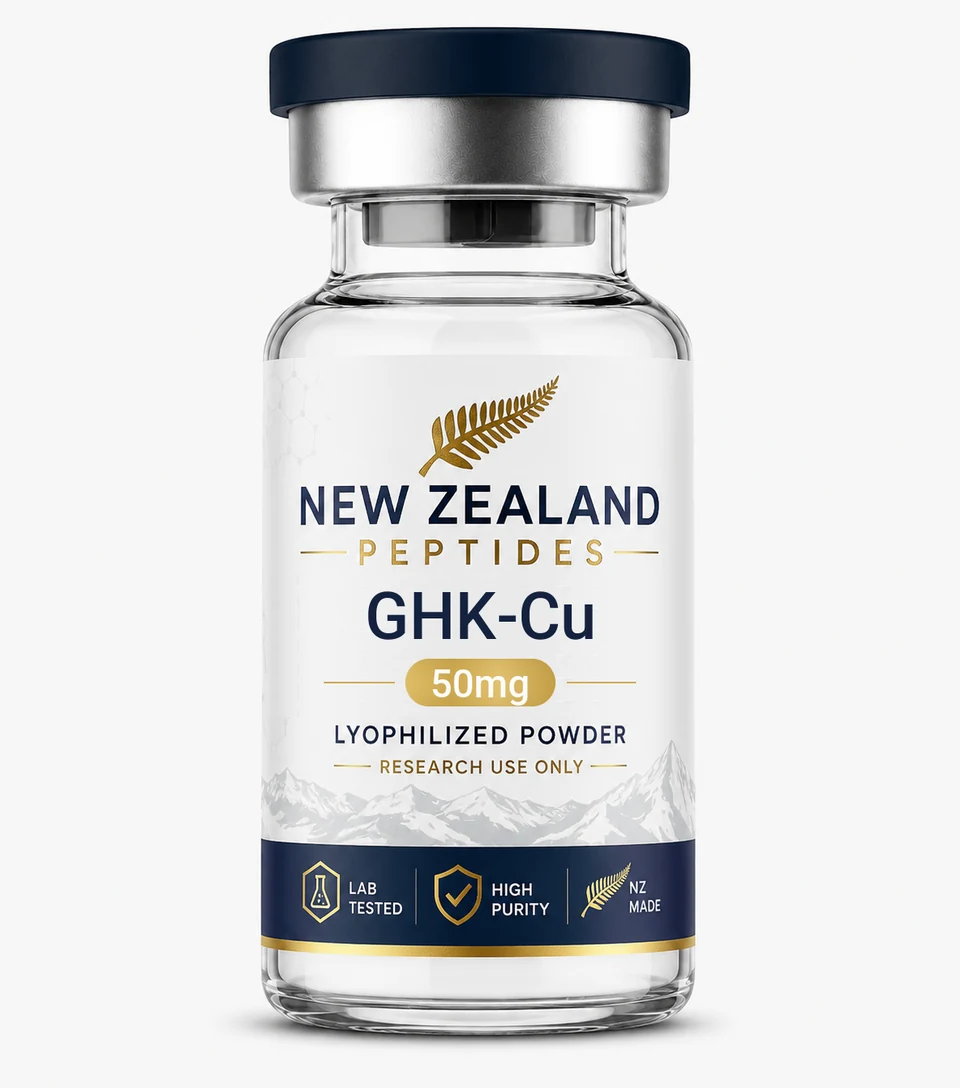
GHK-Cu is unusual among research peptides — its copper complex gives it a visible quality signal. Here is what the colour tells you, what it does not, and how the complexation ratio is verified.
Nearly every research peptide is a white powder that looks identical to every other white powder, which is precisely why documentation carries the entire burden of proof. GHK-Cu is the exception. Its copper complex produces a distinctive deep blue that gives a researcher one genuine visual data point before any instrument is involved.
The tripeptide and its metal
GHK is a three-residue sequence — glycine, histidine, lysine — that binds copper(II) with high affinity. The functional research material is the complex, not the free tripeptide. That distinction matters commercially: GHK and GHK-Cu are different products at different price points, and material sold as GHK-Cu that arrives white rather than blue is almost certainly uncomplexed GHK.
Reading the colour
| Appearance | Interpretation |
|---|---|
| Deep, uniform royal blue | Expected for a correctly complexed lot |
| Pale blue or patchy colour | Possible incomplete complexation; verify the copper ratio on the certificate |
| White or off-white | Uncomplexed GHK, not GHK-Cu |
| Green or brown tint | Likely oxidation or copper speciation change; do not use |
Colour is a screening signal, not a purity measurement. A convincingly blue lot can still fall short on HPLC purity, and dyes can imitate the shade. Use the colour to catch obvious substitution, then rely on the analytical package for everything else.
What the certificate must show
- HPLC purity of the peptide component at 99% or above, with the chromatogram image included.
- Copper content, ideally reported as a molar ratio approaching one copper ion per tripeptide.
- Mass confirmation for the complexed species rather than the free tripeptide alone.
- Water content, because the complex is hygroscopic and moisture accelerates degradation.
- A lot identifier resolving to the public batch register entry for that synthesis run.
Stability, light and pH
GHK-Cu is more sensitive than the incretin analogues in our catalogue. The complex is light-sensitive and pH-sensitive: strongly acidic or strongly alkaline conditions strip copper from the tripeptide, and the colour fades visibly when that happens. Store lyophilised material at -20 °C in an opaque or foil-wrapped container. Once reconstituted, keep it refrigerated, keep it dark, and treat the refrigerated window as shorter than you would allow for a lyophilised incretin analogue.
- Equilibrate the vial to room temperature before opening to prevent condensation on a hygroscopic solid.
- Reconstitute with bacteriostatic water at neutral pH — avoid acidic diluents that would displace the copper.
- Wrap the reconstituted vial in foil or store it in an amber container.
- Record the colour at reconstitution and again before each use; a visible fade is a degradation flag.
- Never refreeze the reconstituted complex.
New Zealand availability
GHK-Cu is held in Auckland stock alongside the rest of our catalogue and ships light-protected by NZ Post Courier, same working day on orders confirmed before 2pm NZST. Delivery is free over NZ$100 including rural delivery addresses, and every vial's lot number resolves to a published certificate showing both the peptide purity and the copper complexation ratio.
GHK-Cu questions
Is GHK-Cu the same as GHK?
No. GHK is the free tripeptide; GHK-Cu is the copper(II) complex. They differ in mass, appearance and research application, and they are priced differently.
My vial is a lighter blue than the product photo. Is it degraded?
Shade varies with cake density and fill volume, so mild variation is normal. A pale, patchy or green cast is not — check the copper ratio on the lot certificate and contact support before proceeding.
Does GHK-Cu need light-protected shipping?
Yes, and we ship it that way as standard. Light exposure over extended periods degrades the complex.
What copper ratio should the certificate report?
A correctly complexed lot approaches a one-to-one molar ratio of copper to tripeptide. Significant deviation indicates incomplete complexation.
Why Ghk-cu new zealand matters to research labs
New Zealand research teams evaluating ghk-cu new zealand face three recurring questions before any in-vitro work begins: is the compound what the label claims, will it remain stable across the planned experimental window, and does the supplier's documentation hold up to the standards a principal investigator will sign off on. The remainder of this article is structured around those three questions.
New Zealand Peptides supplies ghk-cu new zealand as a lyophilised research material packaged for transit at ambient temperatures and long-term storage at −20 °C. Every batch ships with a lot-specific certificate of analysis covering identity, purity, residual solvents and endotoxin where downstream cell culture work is anticipated.
Typical research applications
Across the published literature, ghk-cu new zealand appears most often in three workflow categories. Each has its own documentation profile and storage requirements, which is why a single supplier batch is frequently subdivided across multiple aliquots to limit freeze-thaw cycling.
- In-vitro receptor binding and signalling characterisation, where milligram-scale aliquots are reconstituted fresh on the day of assay.
- Pharmacokinetic and stability modelling, where reconstituted material is sampled at defined time-points and analysed by RP-HPLC.
- Comparative reference work, where ghk-cu new zealand is benchmarked against in-house standards or other published research compounds.
Reconstitution and handling reference
Lyophilised ghk-cu new zealand is reconstituted with sterile bacteriostatic water using slow, side-of-vial addition to avoid foaming. The vial is allowed to dissolve passively rather than being shaken; mechanical agitation accelerates aggregation in many peptide systems and complicates downstream analytical work. The table below summarises common reconstitution volumes used as documentation references.
| Vial Strength | Diluent Volume | Resulting Concentration |
|---|---|---|
| 5 mg | 1.0 mL bacteriostatic water | 5 mg/mL |
| 10 mg | 1.0 mL bacteriostatic water | 10 mg/mL |
| 10 mg | 2.0 mL bacteriostatic water | 5 mg/mL |
| 30 mg | 3.0 mL bacteriostatic water | 10 mg/mL |
Quality benchmarks New Zealand Peptides publishes
| Parameter | New Zealand Peptides Spec | Method |
|---|---|---|
| HPLC purity | ≥ 98% | RP-HPLC, UV 214 nm |
| Identity | ± 0.5 Da of theoretical mass | LC-MS or MALDI-TOF |
| Endotoxin | Reported per lot | LAL kinetic chromogenic |
| Counterion | Quantified | Ion chromatography |
| Water content | < 8% (typical lyophilised) | Karl Fischer |
Frequently asked research questions
Is the ghk-cu new zealand supplied by New Zealand Peptides intended for human use?
No. All New Zealand Peptides material is supplied strictly for in vitro and laboratory research use. Nothing on this page constitutes medical, veterinary or therapeutic advice.
How is ghk-cu new zealand shipped and how long is the transit-stable window?
Material is dispatched as a lyophilised powder, sealed and protected from light. Transit at ambient temperatures over typical New Zealand courier timelines is well within the published stability envelope for this compound class.
Will a Certificate of Analysis be provided with my ghk-cu new zealand order?
Yes. Every batch ships with a lot-specific COA covering identity, purity and the analytical parameters listed in the quality benchmarks section above.
Can I request a specific batch or repeat lot of ghk-cu new zealand?
Repeat-lot requests are supported for ongoing research programs; contact the New Zealand Peptides research desk with the previous COA reference and the team will hold inventory from a matching batch where available.
Further reading
Continue with the related New Zealand Peptides research references linked at the foot of this article, or browse the full research catalogue for the compound class profile, lab-results archive and laboratory documentation. For sourcing questions, the research team is available via the New Zealand Peptides contact page.