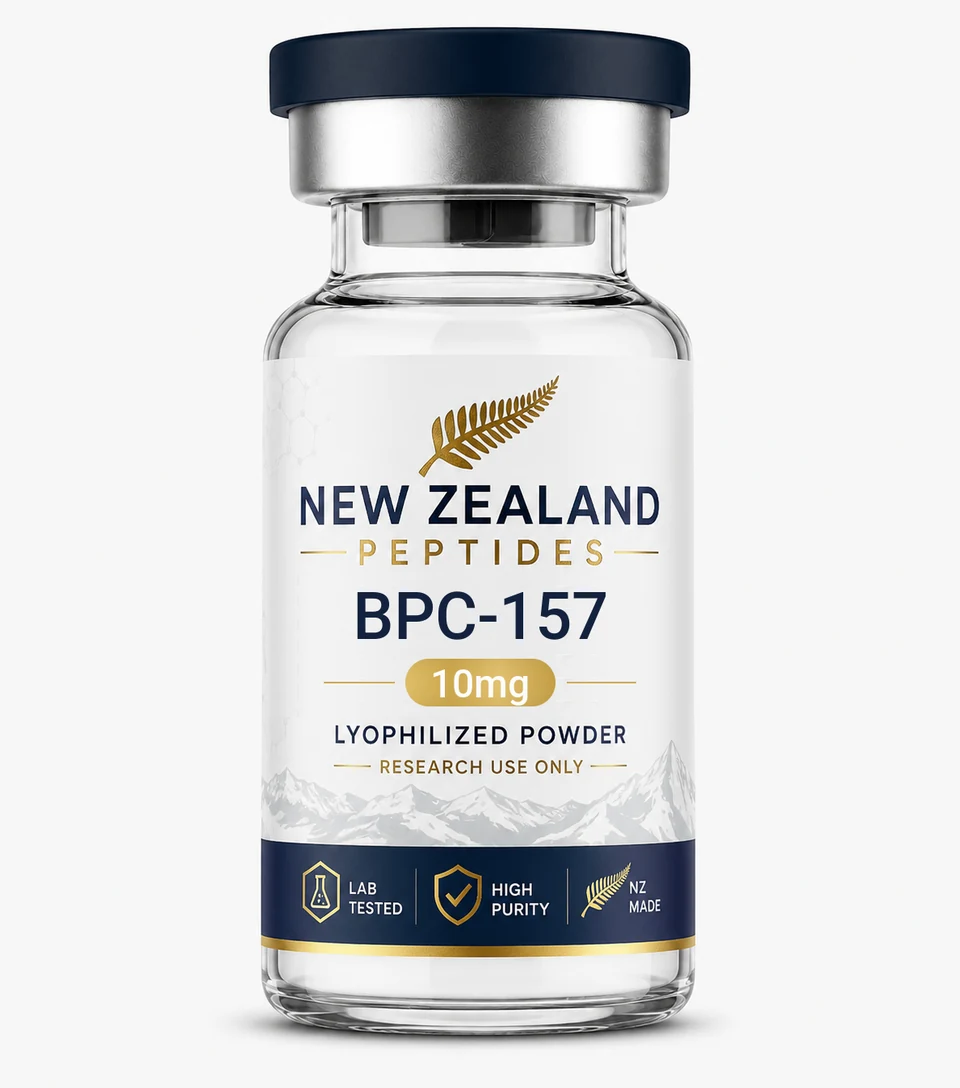
BPC-157 and TB-500 are short, cheap to fake and widely misrepresented. These are the identity and stability checks that separate genuine material from a mislabelled vial.
Short peptides attract counterfeiting for an unglamorous reason: they are cheap to synthesise badly and difficult for a buyer to check by eye. BPC-157 and TB-500 sit at the top of that list. Both are widely stocked, both are frequently misrepresented, and both reward a researcher who knows which two numbers to check.
BPC-157: what the sequence actually is
BPC-157 is a fifteen-residue pentadecapeptide, a partial sequence derived from a protein found in gastric juice. Its short chain means it is comparatively simple to synthesise, and it is unusually stable in aqueous solution relative to longer peptides. Fifteen residues also means the theoretical mass is tightly defined, so a mass spectrum either matches or it does not — there is very little room for ambiguity.
Acetate versus arginate
BPC-157 is supplied in two salt forms and the distinction is genuinely consequential. Acetate is the conventional form and the one referenced across the majority of published work. Arginate is marketed on solubility and stability grounds. They are not the same product, they do not carry the same mass, and a certificate that does not state which form is in the vial is incomplete. We state the salt form explicitly on every lot record.
TB-500: a fragment, not the whole protein
TB-500 is routinely and incorrectly described as thymosin beta-4. It is not. Thymosin beta-4 is a 43-residue protein; TB-500 is a synthetic seven-residue fragment corresponding to the actin-binding region of that protein. The mass difference is enormous and immediately visible on a mass spectrum. Any supplier describing TB-500 and thymosin beta-4 as interchangeable is either careless or hoping you are.
Identity checkpoints for both compounds
- Confirm the observed deconvoluted mass against the theoretical mass for the stated sequence and salt form.
- For BPC-157, check that the salt form is named — acetate and arginate carry different masses and different solubility profiles.
- For TB-500, confirm the certificate describes a fragment and not full-length thymosin beta-4.
- Verify HPLC main-peak area at 99% or above, with the chromatogram image supplied.
- Match the printed vial lot to the public batch register entry before opening.
Solubility and handling
| Property | BPC-157 | TB-500 |
|---|---|---|
| Chain length | 15 residues | 7 residues |
| Aqueous solubility | Readily soluble in bacteriostatic water | Readily soluble in bacteriostatic water |
| Lyophilised storage | -20 °C, light protected | -20 °C, light protected |
| Reconstituted window | Up to 30 days at 2–8 °C | Up to 30 days at 2–8 °C |
Both compounds dissolve without difficulty and neither requires an acidic diluent under normal conditions. As with all our lyophilised stock, add diluent slowly against the vial wall and let dissolution happen without agitation. The short chain length of TB-500 in particular makes it forgiving of handling, but foam is still worth avoiding.
Why we test these two harder than most
Because the counterfeit rate is high, BPC-157 and TB-500 lots go through the same 99% HPLC release threshold and LC-MS identity confirmation as every other compound in our catalogue, with the salt form and fragment identity called out explicitly on the public record. Both are held in New Zealand stock in Auckland and dispatched same working day before 2pm NZST.
Common identity questions
Is TB-500 the same as thymosin beta-4?
No. TB-500 is a seven-residue synthetic fragment of the actin-binding region; thymosin beta-4 is the full 43-residue protein. They differ enormously in mass and are trivially distinguishable by mass spectrometry.
Which BPC-157 salt form do you stock?
The salt form is stated explicitly on each lot record and on the product page, so you know before ordering rather than after opening.
Can BPC-157 and TB-500 be reconstituted in the same vial?
We supply them as separate single-compound vials so that identity and concentration remain independently verifiable. Blending is a decision for your protocol, not our packaging.
Why are these two counterfeited so often?
Short sequences are cheap to produce, and buyers rarely request mass confirmation. Requiring an LC-MS trace removes most of the incentive.
Why Bpc-157 nz matters to research labs
New Zealand research teams evaluating bpc-157 nz face three recurring questions before any in-vitro work begins: is the compound what the label claims, will it remain stable across the planned experimental window, and does the supplier's documentation hold up to the standards a principal investigator will sign off on. The remainder of this article is structured around those three questions.
New Zealand Peptides supplies bpc-157 nz as a lyophilised research material packaged for transit at ambient temperatures and long-term storage at −20 °C. Every batch ships with a lot-specific certificate of analysis covering identity, purity, residual solvents and endotoxin where downstream cell culture work is anticipated.
Typical research applications
Across the published literature, bpc-157 nz appears most often in three workflow categories. Each has its own documentation profile and storage requirements, which is why a single supplier batch is frequently subdivided across multiple aliquots to limit freeze-thaw cycling.
- In-vitro receptor binding and signalling characterisation, where milligram-scale aliquots are reconstituted fresh on the day of assay.
- Pharmacokinetic and stability modelling, where reconstituted material is sampled at defined time-points and analysed by RP-HPLC.
- Comparative reference work, where bpc-157 nz is benchmarked against in-house standards or other published research compounds.
Storage and stability envelope
Lyophilised bpc-157 nz is documented as stable for 24+ months at −20 °C protected from light. Once reconstituted, the published storage reference for most research peptides in this class is up to 30 days at 2–8 °C when handled aseptically; longer-term storage of reconstituted material is best achieved by single-use aliquoting at −80 °C to remove freeze-thaw variables from later analytical reads.
- Avoid storing reconstituted vials in the refrigerator door — temperature swings shorten usable life.
- Label aliquots with batch ID, reconstitution date and concentration so retrospective audit is straightforward.
- Do not refreeze previously thawed aliquots; integrate single-use volumes into the assay design from the outset.
Certificate of analysis — what to verify
Every New Zealand Peptides bpc-157 nz lot is dispatched with a certificate of analysis (COA) tied to the batch identifier printed on the vial. Reviewing the COA before the material enters the workflow is the single highest-leverage quality control step a research lab can perform.
- Batch / lot identifier and synthesis date — both must match the vial.
- RP-HPLC purity, typically ≥98% for research-grade bpc-157 nz.
- Mass-spectrometry identity confirmation (LC-MS or MALDI-TOF) within ±0.5 Da of the theoretical mass.
- Counterion identity and percent (acetate or trifluoroacetate are the most common).
- Bacterial endotoxin per the published analytical method, reported in EU/mg.
- Residual solvents and water content where the synthesis route makes them analytically meaningful.
Quality benchmarks New Zealand Peptides publishes
| Parameter | New Zealand Peptides Spec | Method |
|---|---|---|
| HPLC purity | ≥ 98% | RP-HPLC, UV 214 nm |
| Identity | ± 0.5 Da of theoretical mass | LC-MS or MALDI-TOF |
| Endotoxin | Reported per lot | LAL kinetic chromogenic |
| Counterion | Quantified | Ion chromatography |
| Water content | < 8% (typical lyophilised) | Karl Fischer |
Frequently asked research questions
Is the bpc-157 nz supplied by New Zealand Peptides intended for human use?
No. All New Zealand Peptides material is supplied strictly for in vitro and laboratory research use. Nothing on this page constitutes medical, veterinary or therapeutic advice.
How is bpc-157 nz shipped and how long is the transit-stable window?
Material is dispatched as a lyophilised powder, sealed and protected from light. Transit at ambient temperatures over typical New Zealand courier timelines is well within the published stability envelope for this compound class.
Will a Certificate of Analysis be provided with my bpc-157 nz order?
Yes. Every batch ships with a lot-specific COA covering identity, purity and the analytical parameters listed in the quality benchmarks section above.
Can I request a specific batch or repeat lot of bpc-157 nz?
Repeat-lot requests are supported for ongoing research programs; contact the New Zealand Peptides research desk with the previous COA reference and the team will hold inventory from a matching batch where available.
Further reading
Continue with the related New Zealand Peptides research references linked at the foot of this article, or browse the full research catalogue for the compound class profile, lab-results archive and laboratory documentation. For sourcing questions, the research team is available via the New Zealand Peptides contact page.